Guides3 min read
Resin vs Filament 3D Printing: Detail or Toughness?
Resin vs filament 3D printing compared: detail, strength, size, finish and heat, and which suits your part. A plain guide from our Melbourne print studio.
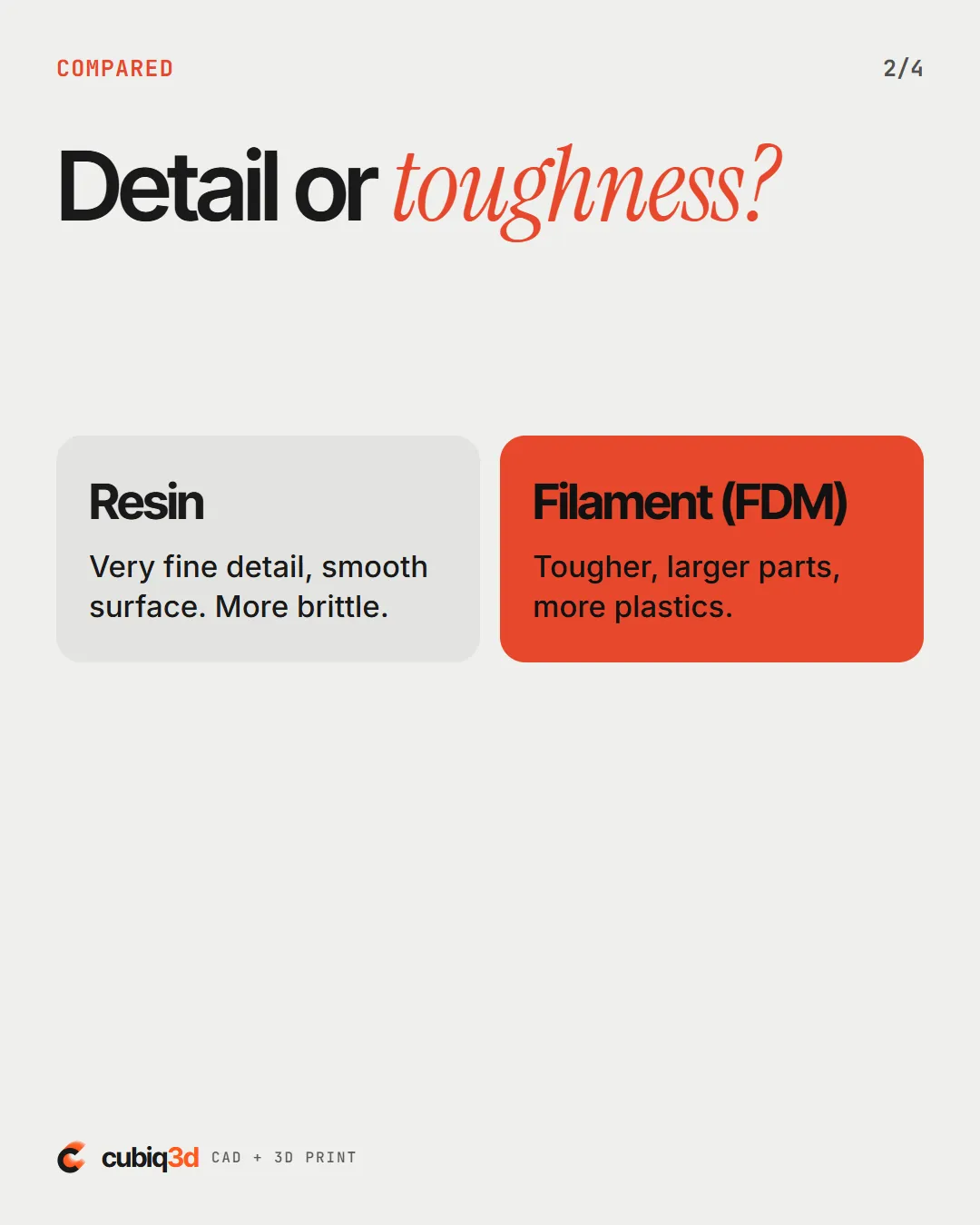
There are two kinds of 3D printing most people come across. Filament printers (FDM) melt a plastic thread and draw each layer with it. Resin printers cure a liquid resin with light, a layer at a time. Both make real parts from a CAD file, but they have very different strengths. In short, resin vs filament 3D printing is a choice between fine detail and toughness. We run both at our Melbourne studio, so we pick per part. Here is how to tell which suits yours.
How each one works
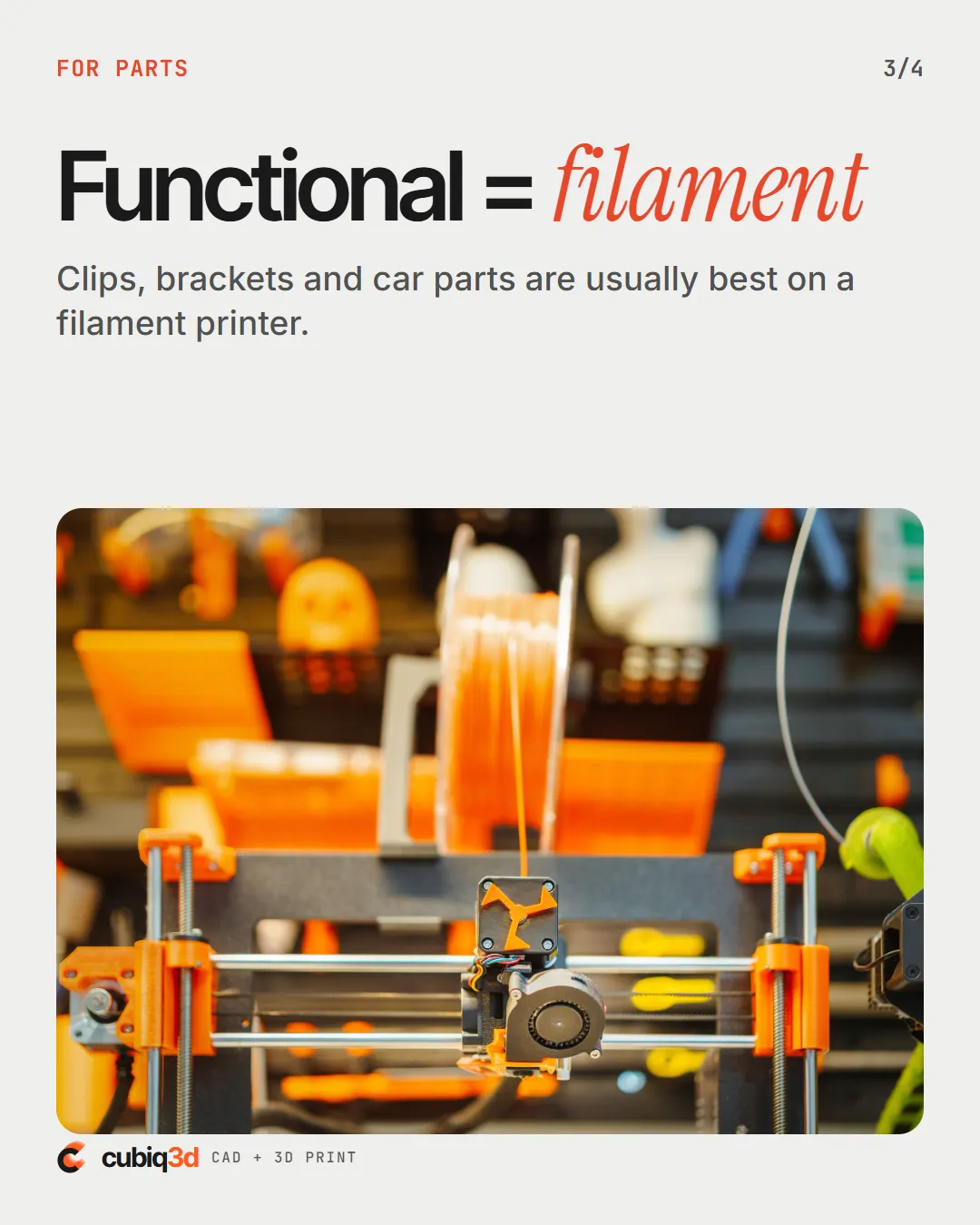
A filament printer feeds a plastic thread, usually 1.75 mm thick, into a heated nozzle and draws each layer with a fine bead of molten plastic. The part builds up from the bed, layer on layer. It works with a wide range of plastics, from easy PLA to tough PETG, heat-resistant ABS and flexible TPU.
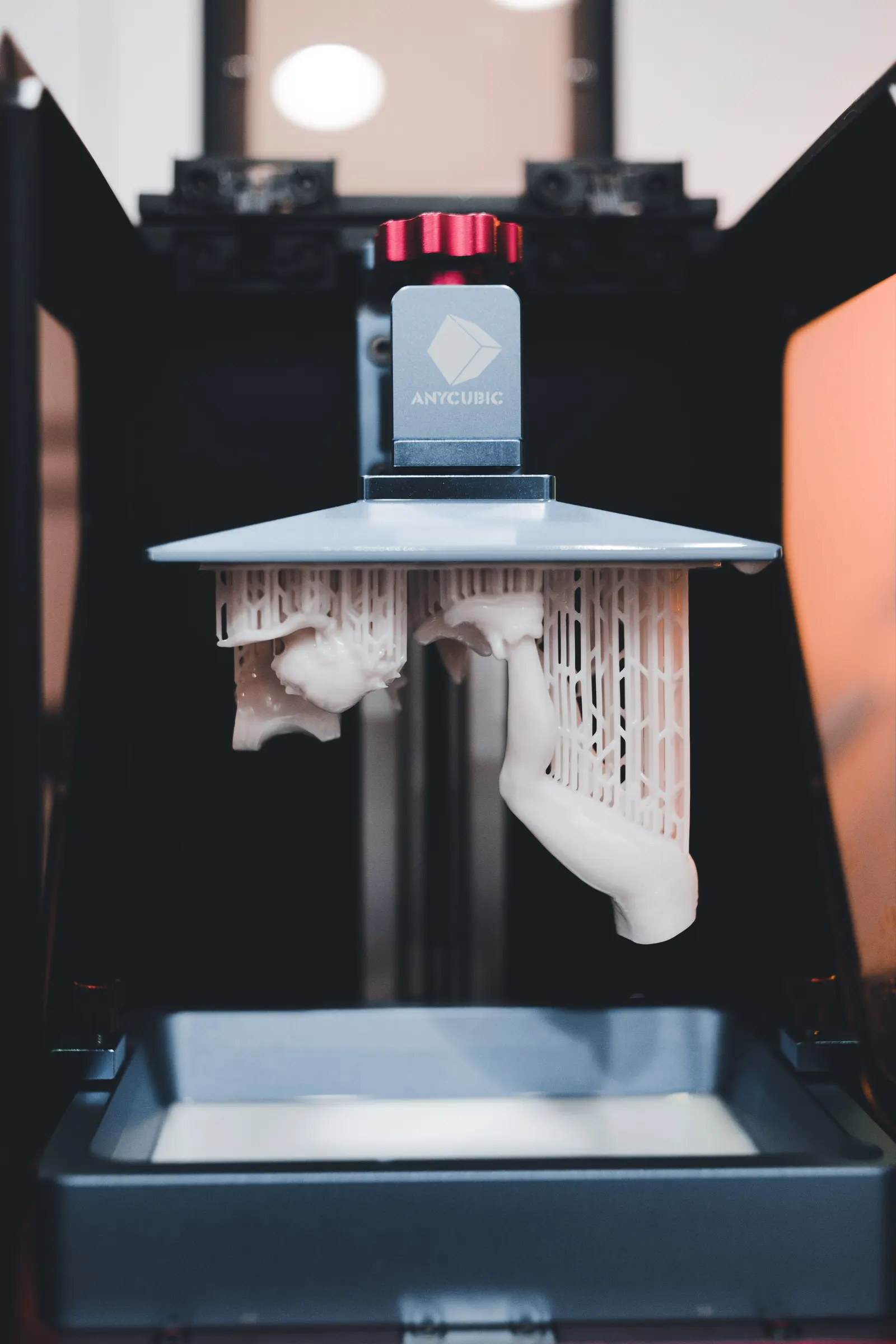
A resin printer has a vat of liquid resin and a light source underneath, usually a screen that shows each layer as an image. Where light hits, the resin hardens. The part is built hanging upside down from a build plate that lifts a fraction of a millimetre after each layer. After printing, parts are washed to remove uncured resin and then cured under UV light to reach full strength.
Resin vs filament 3D printing, side by side
| Resin | Filament (FDM) | |
|---|---|---|
| Detail | Very fine; small text and sharp edges | Good; limited by nozzle width |
| Surface | Smooth, layer lines barely visible | Visible layer lines |
| Toughness | Standard resins are brittle; tougher resins exist | Tough, especially PETG, ABS and TPU |
| Part size | Usually smaller | Larger parts are practical |
| Materials | Resin types: standard, tough, flexible and others | PLA, PETG, ABS, TPU and engineering plastics |
| Heat and sun | Most resins weaken with heat and long UV exposure | Depends on plastic; ABS and ASA handle heat |
| Post-processing | Wash, cure and remove supports | Remove any supports; often ready to use |
| Best for | Detail models, small precise parts, smooth samples | Functional parts: clips, brackets, enclosures, car parts |
When resin is the better choice
- Small parts with fine detail: miniatures, small knobs with fine knurling, detailed models.
- Smooth surfaces for display, photography or product samples.
- Tiny features that are smaller than a filament nozzle can lay down, such as small raised text.
- Parts that will be moulded or cast from, where the surface finish carries through.
- Small, precise parts where crisp edges matter more than impact strength.
When filament is the better choice
- Functional parts that take load, flex or get knocked: brackets, clips, mounts, hooks.
- Anything in a car, outdoors, or somewhere warm, where you need a specific plastic such as ABS or PETG.
- Larger parts, such as enclosures, panels and jigs.
- Flexible parts in TPU.
- Parts that need to be drilled, tapped or screwed into.
Handling and finishing resin parts
Resin parts need more finishing than filament parts. Supports leave small marks that are sanded off, and every part is washed and cured before it is handled normally, because uncured resin should not touch skin. Fully cured parts are safe to handle like any other plastic object, but they still are not meant for food contact. Filament parts, by contrast, are usually ready to use once any supports are removed. That extra work is worth it when detail matters and unnecessary when it does not.
A part that is both detailed and tough?
Sometimes a part needs fine detail and toughness at once, such as a small clip with a crisp latch. There are a few routes: a tough engineering resin, a filament print with the small features redesigned to suit the nozzle, or splitting the job so the detailed piece is resin and the load-bearing piece is filament. We will suggest the one that suits your part.
Quick question
What matters most for your part?
We print in both resin and filament on our 3D printing service. For smooth display samples and fit checks, see prototyping, and the materials guide compares each plastic in detail.
Questions people ask
Is resin stronger than filament?
Standard resin is stiff but brittle. For parts that take knocks or flex, filament plastics like PETG and ABS are usually tougher. Tough resins narrow the gap.
Is resin printing more accurate?
For small parts and fine detail, generally yes. Resin is not limited by a nozzle's bead width, so it shows sharper edges and smaller features.
Can resin prints go outside?
Most standard resins become brittle and discolour with long UV exposure. For outdoor parts, a UV-resistant filament plastic is a better choice.
Do you do resin printing in Melbourne?
Yes. We print in resin as well as PLA, PETG, ABS and TPU filament, and choose per part.