Guides3 min read
3D Printing vs CNC Machining: Which Suits Your Part?
3D printing vs CNC machining compared: how each works, materials, tolerances, shapes and quantities, and how to choose for your part. From our Melbourne studio.
Both start from the same CAD file, and both end with a real part in your hand. But 3D printing vs CNC machining is a choice between two opposite ways of making something: one builds plastic up layer by layer, the other cuts a solid block down until only the part is left. Each is the right answer for different jobs. We are a 3D printing and CAD studio in Melbourne, so we will be upfront about when printing suits your part and when a machine shop is the better call.
How each process works
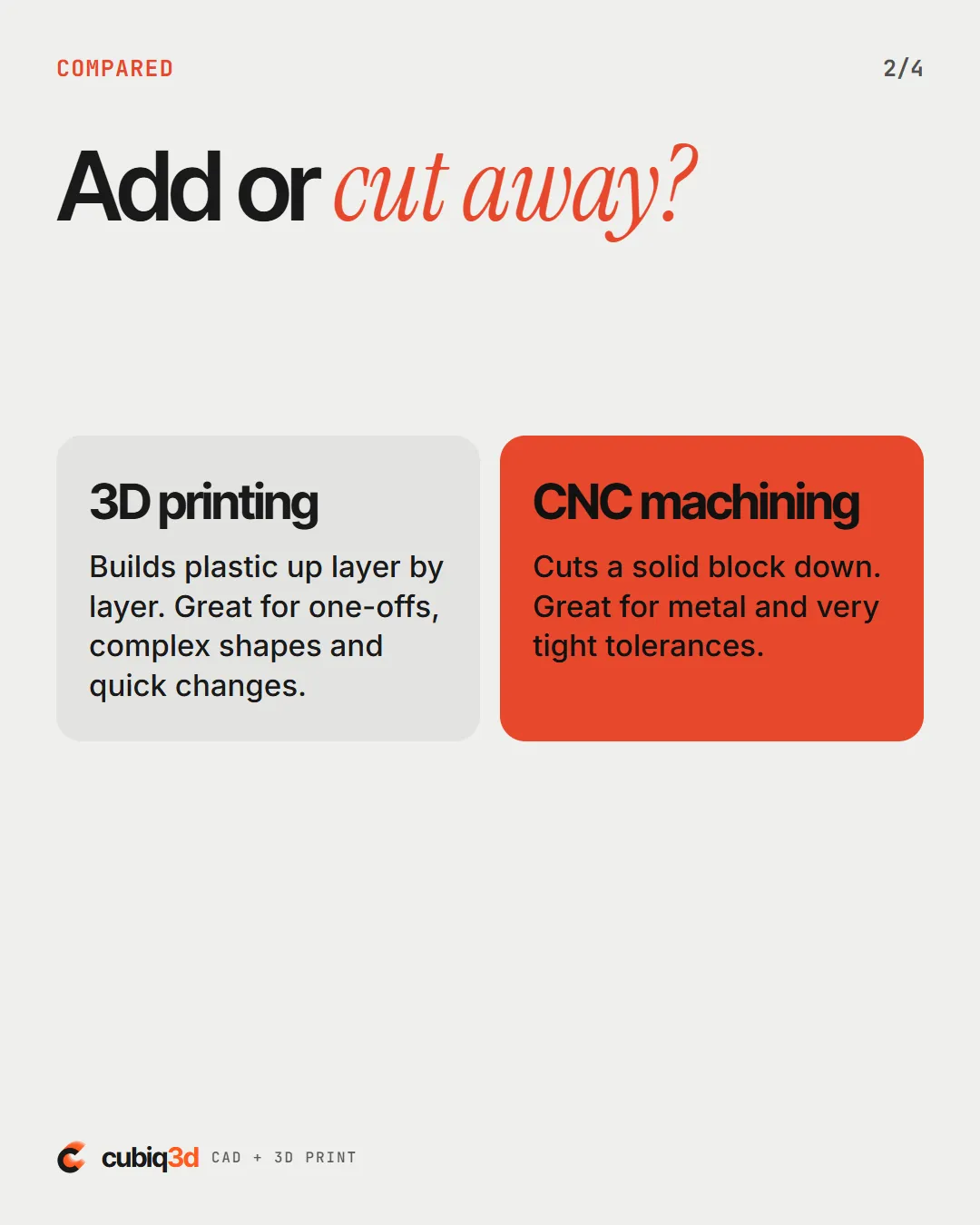
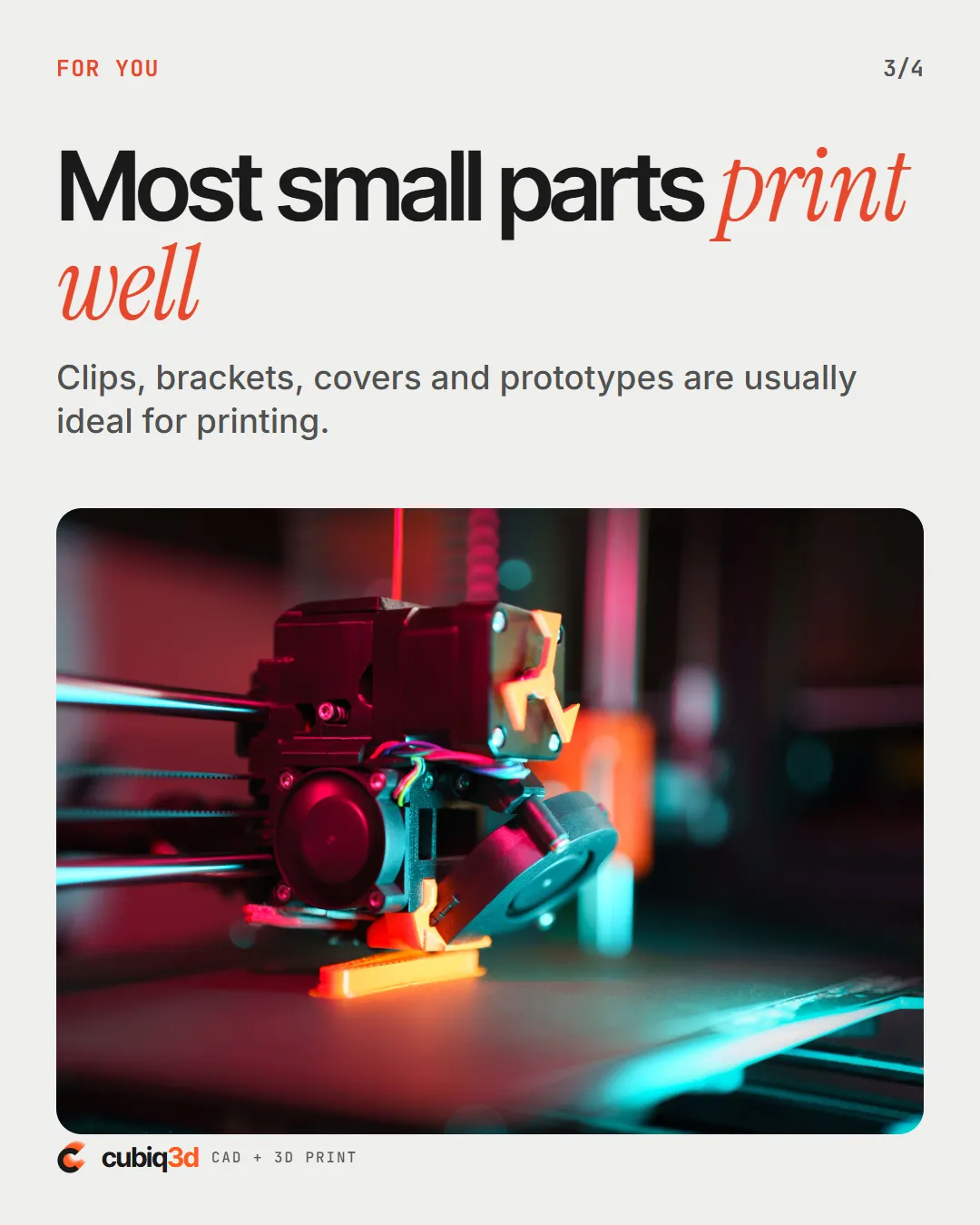
3D printing is additive. A filament printer melts plastic and lays it down in thin lines, one layer at a time, building the part from the bed up. Resin printers do the same with liquid resin cured by light. There is no cutting tool, so internal channels, undercuts and organic shapes cost little extra.
CNC machining is subtractive. A spinning cutter, guided by a toolpath generated from the CAD model, removes material from a solid block of metal or plastic. Because the block is solid and uniform, the finished part has the full strength of the stock material in every direction, and the cutter can hold very tight sizes. The trade-off is that the cutter has to reach every surface, which limits some shapes, and setting up a job takes time and skilled programming.
3D printing vs CNC machining, side by side
| 3D printing (FDM / resin) | CNC machining | |
|---|---|---|
| How it works | Adds material layer by layer | Cuts material away from a block |
| Materials | Plastics: PLA, PETG, ABS, TPU, resins and more | Metals (aluminium, steel, brass) and engineering plastics |
| Strength | Good, but weaker between layers | Full strength of the solid stock |
| Tolerances | Typically a few tenths of a mm; fits designed in | Very tight tolerances are routine |
| Shapes | Internal channels, undercuts, organic forms | Limited by where the cutter can reach |
| Set-up | Minimal: slice the file and print | Toolpaths, fixturing and tooling for each job |
| Design changes | Edit CAD and reprint | Re-program and often re-fixture |
| Best quantity | One-offs to small batches | One-offs to production, especially in metal |
| Surface | Visible layer lines unless finished | Machined finish, can be very smooth |
When 3D printing is the better choice
- One-off plastic parts: a broken clip, knob, cover or bracket that is no longer sold.
- Prototypes you will change. Edit the CAD model, reprint, test again.
- Complex shapes: curved trim, enclosures with internal bosses and clips, parts with hollow sections.
- Flexible parts. TPU makes bumpers, feet and seals that a mill cannot.
- Small batches of plastic parts where tooling for moulding would not make sense.
When CNC machining is the better choice
- Metal parts: anything that needs the strength, heat resistance or wear of aluminium or steel.
- Very tight tolerances, such as bearing bores and precision mating faces.
- Parts that carry high loads or are safety-critical.
- Parts that must match a machined original exactly in material and finish.
What about injection moulding?
Moulding is the third option, and it is how most of the plastic parts around you were made. It needs a steel or aluminium mould, which is a big up-front cost, but each part after that is fast and cheap. It suits thousands of identical parts. For one part or a few dozen, printing almost always makes more sense.
Which suits your part?
Quick question
What does your part need most?
We do 3D printing and CAD design, not machining. A CAD model we draw for you is yours, and can go to a machine shop as easily as to our printers. If you are developing something new, our prototyping service is the place to start.
Questions people ask
Is 3D printing cheaper than CNC machining?
For one-off plastic parts and prototypes it usually is, because there is little set-up. For metal parts or very tight tolerances, machining is often the only sensible option.
Is a 3D printed part as strong as a machined one?
Not in the same material, because prints are weaker between layers. But printed parts are strong enough for many clips, brackets, covers and housings when designed for printing.
Do you do CNC machining?
No. We do CAD design and 3D printing in Melbourne. We can model a part for machining and print a test version to check fit before it goes to a machine shop.
Can a 3D printed part replace a machined part?
Sometimes, for lightly loaded plastic parts. For metal, high loads, heat or precision fits, we'll recommend machining instead.