How we work5 min read
How to Get a 3D Printing Quote (Without the Back and Forth)
How to get a 3D printing quote in one go: upload a file for an instant estimate, or send a photo and sizes. What we need, and what happens next in Melbourne.

Most quote requests stall on the same thing: a photo with no sense of size, or a size with no idea what the part does. Then it takes four or five messages to get to a price. This guide covers how to get a 3D printing quote in one go, whether you already have a 3D file or just a broken part in your hand, and what happens after you send it to our Melbourne studio.
Two ways to get a 3D printing quote
Want a number now? Our instant 3D printing quote slices your file in the browser and shows an estimate in seconds, then we confirm a fixed quote.
| You have a 3D file | You have a part, photo or sketch | |
|---|---|---|
| Where to start | Upload it at /quote | Email, WhatsApp or text a photo |
| File types | STL, STEP, OBJ or 3MF | Any phone photo, plus sizes in mm |
| What you see first | An estimate in your browser, worked out from real toolpaths | A reply from us, with questions if anything is unclear |
| Then | One fixed quote by email | One fixed quote by email, including the CAD work |
If you have a file, the fastest route is our online quote page. Our slicer cuts the part into layers right in your browser and shows the print time and an estimate before you send us anything. If you don't have a file, that is completely normal. Most of our jobs start as a photo of a snapped clip or a rough sketch, and we model the part in CAD first.
What we need for a quote
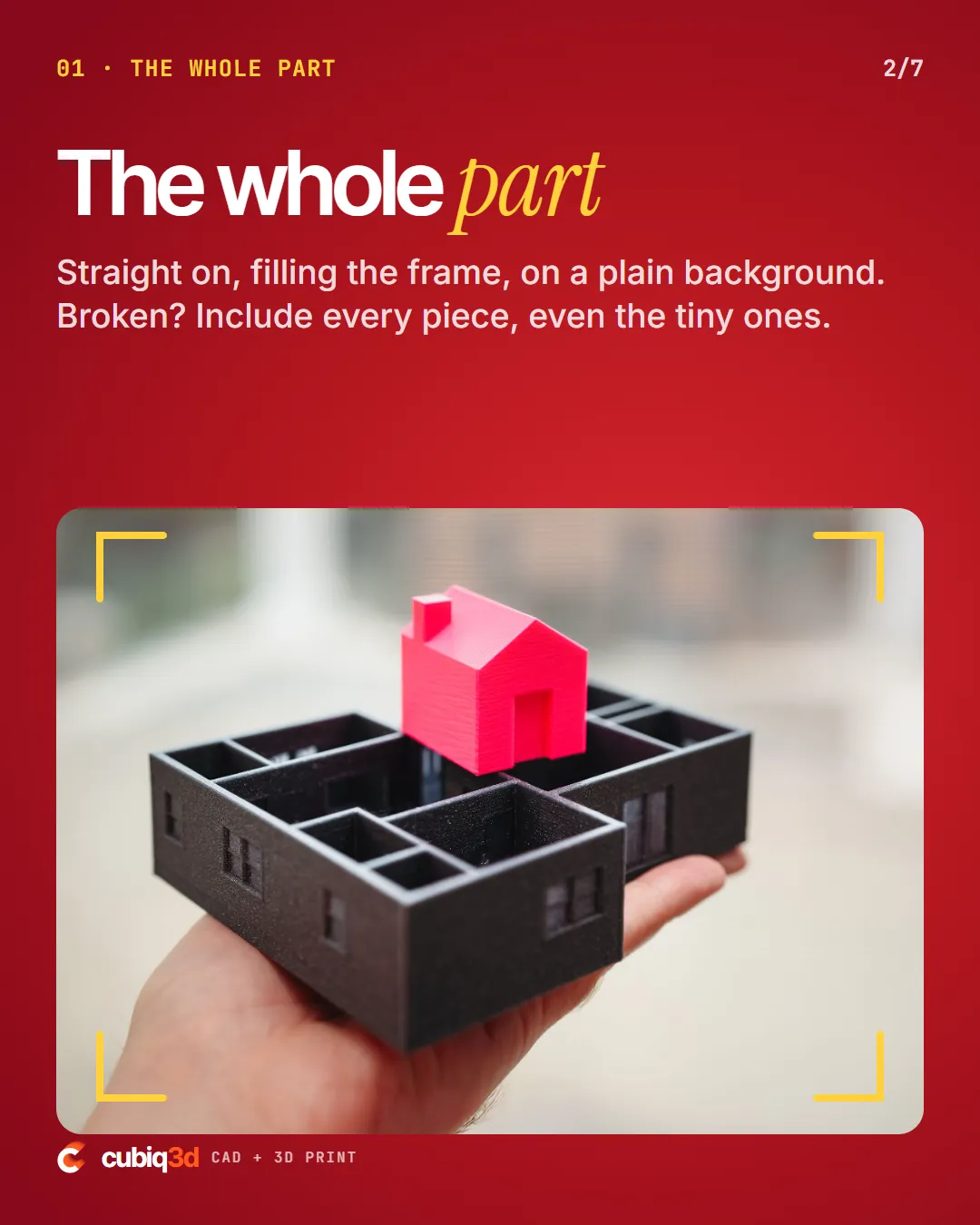
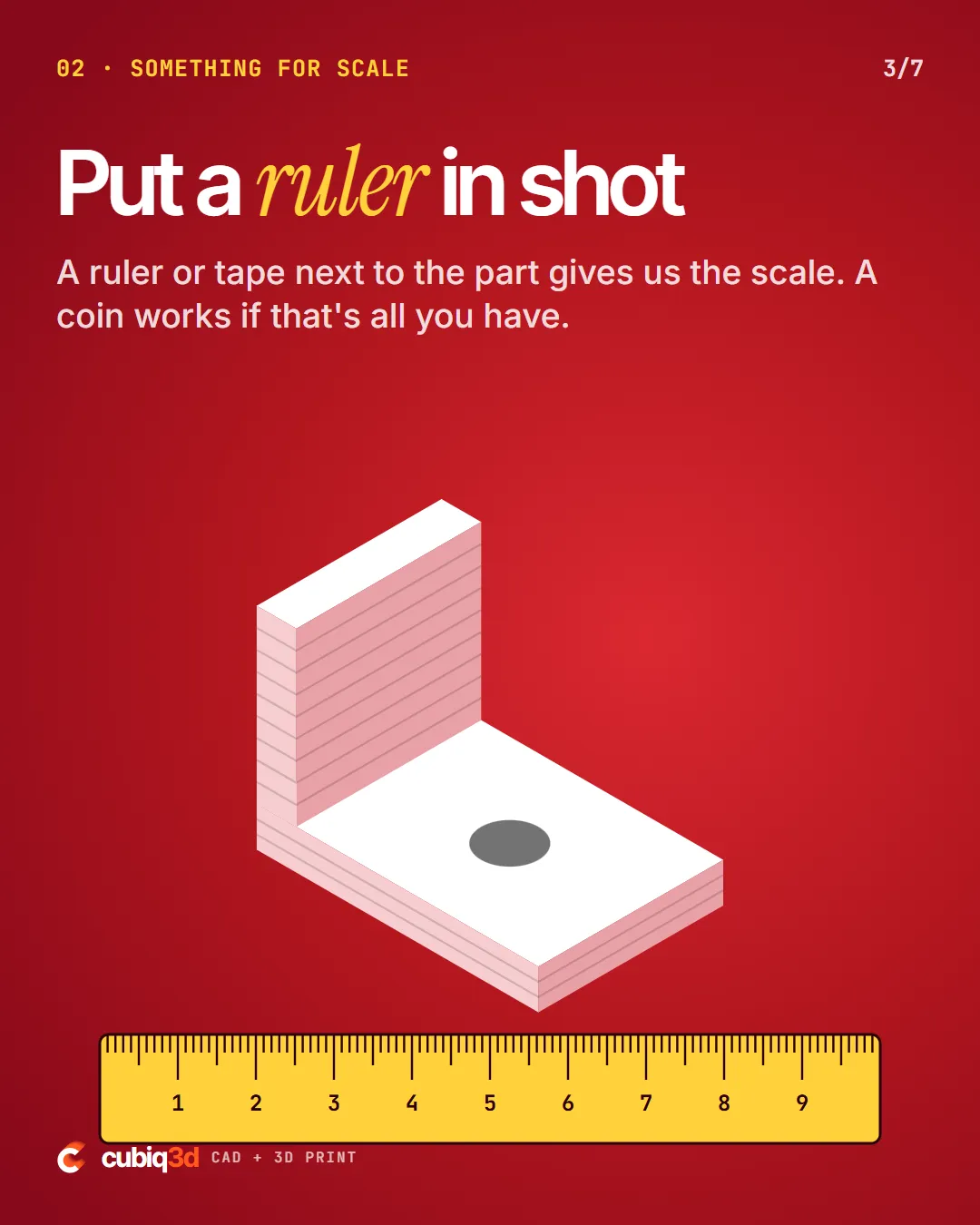
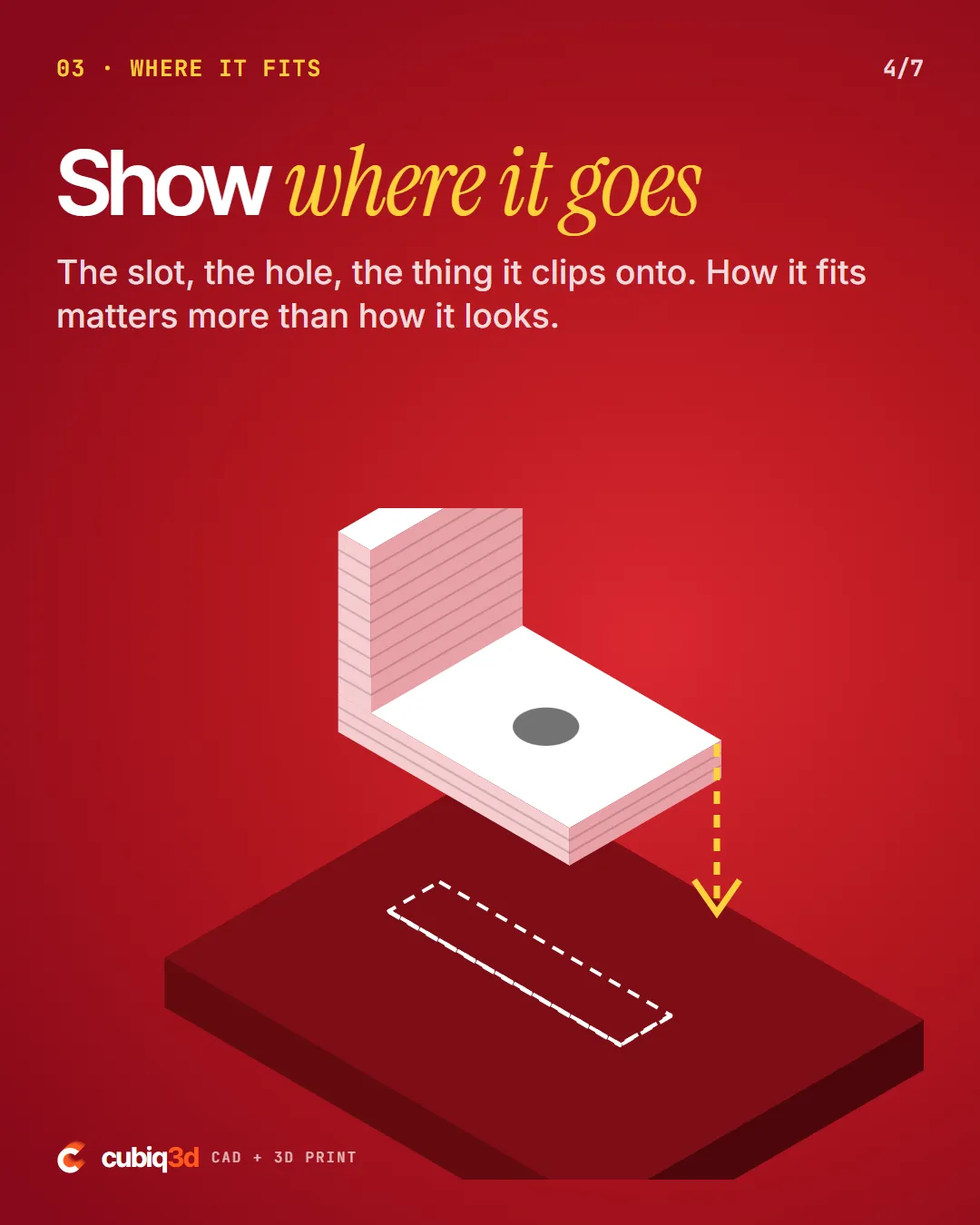
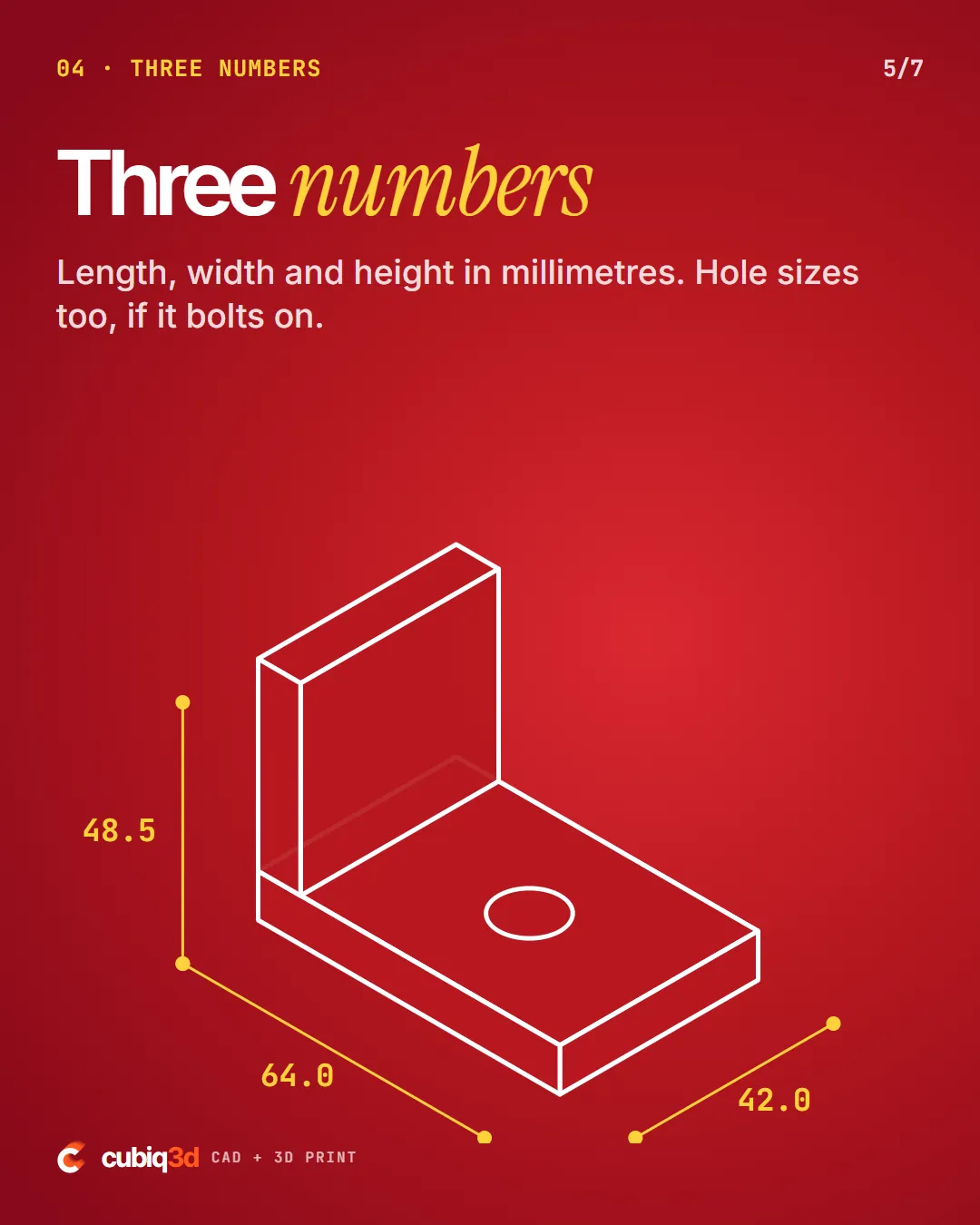
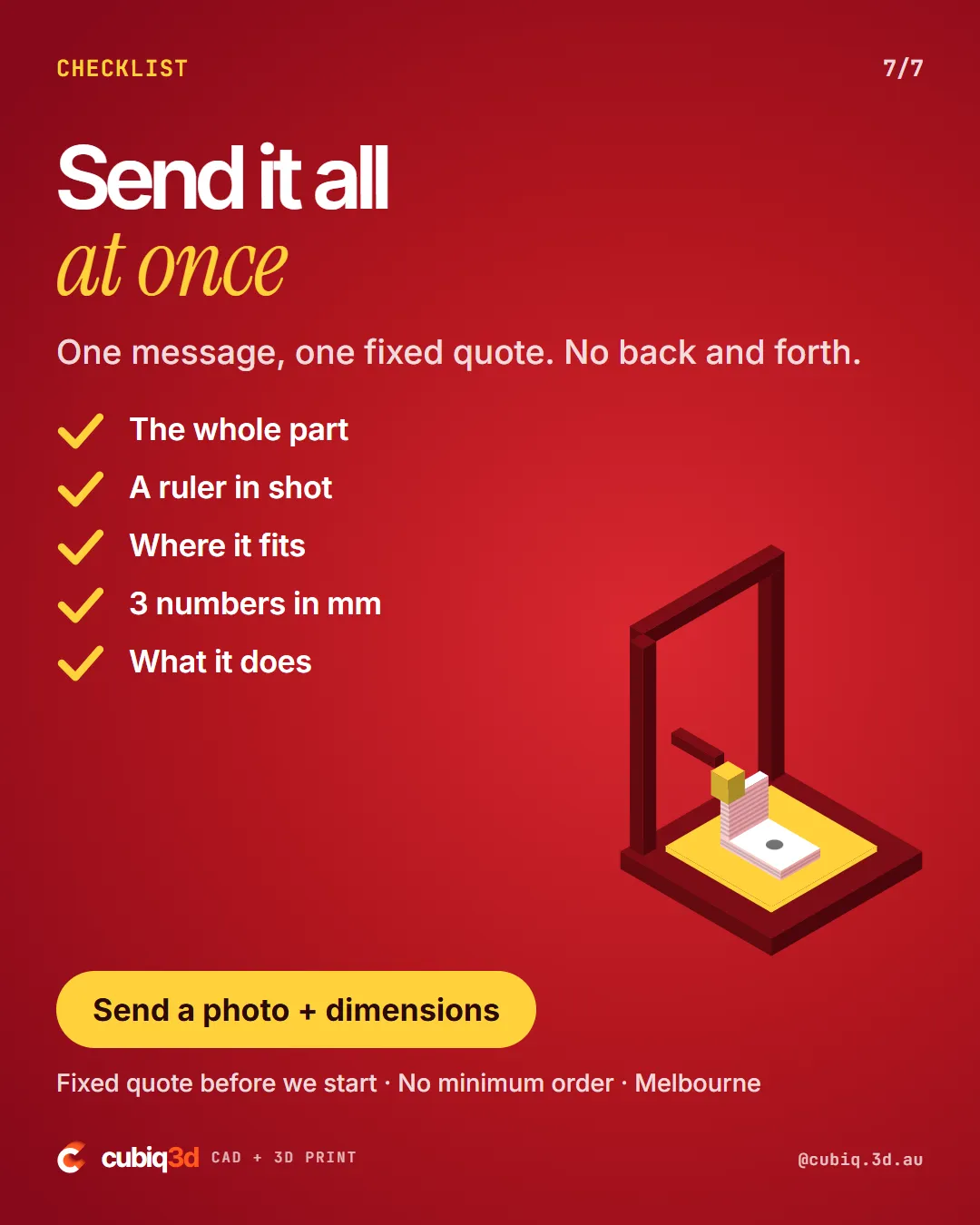
Four things let us price almost any part without a string of follow-up questions. You don't need technical drawings or CAD skills; a phone and a ruler are enough.
Tick these off before you hit send
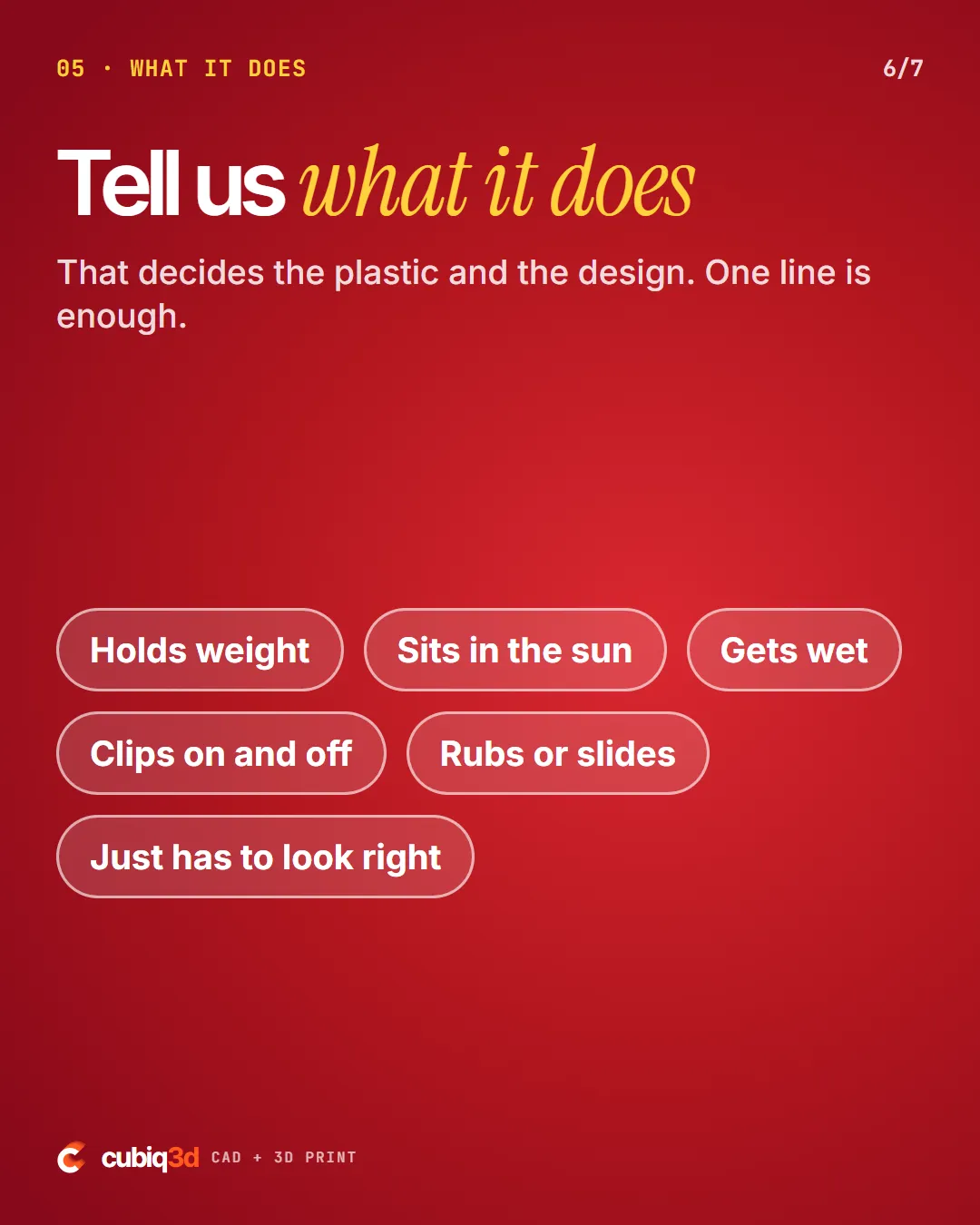
0/6The line about what the part does matters more than people expect. It decides the plastic and the design. A bracket that holds a shelf, a clip that lives on a car dashboard and a knob in a steamy bathroom all need different choices, even if they are the same size. Our materials guide explains why.
What happens after you send it
- 1You send a photo or a fileUpload at /quote for an instant estimate, or send a photo with the main sizes by email, WhatsApp or text.
- 2We reply with questions or a quoteIf something is unclear, like a hidden hole or how a clip engages, we ask once. Otherwise you get one fixed price and a ready date by email.
- 3You decideNothing is modelled or printed until you agree to the price. No pressure, and no surprise costs later.
- 4We model, check and printWe build the part in CAD, check the fit (with a quick test piece for tight fits), then print it in the plastic that suits the job.
- 5Pick up or postCollect it in Melbourne or have it posted. We confirm which in the quote email.
Why a fixed quote, not an hourly rate
Custom parts are hard to price on the fly, and an open-ended rate leaves you guessing. We'd rather do the thinking up front: look at the part, work out how it should be modelled and printed, and give you one number. That number is what you pay. If we find while modelling that the part is very different from what we were told, we tell you before going further, rather than quietly adding to the bill.
What changes the price
- How much plastic the part uses and how long it takes to print
- The material: TPU and resin behave differently to PLA or PETG
- Whether we need to model it from a photo or sketch, or print your file as is
- How many copies you need, since a batch can share the same setup
What holds a quote up
When a quote takes longer than it should, it's almost always for one of a few reasons. None of them are your fault; they're just things a photo can't show on its own.
- No scale in the photo, so a 15 mm clip and a 150 mm bracket look the same
- A hidden feature, like a hole on the underside or a tab behind a panel
- No idea where the part lives, so we can't choose between PLA, PETG, ABS or TPU
- A quantity that changes after the quote, since a batch is priced differently to one part
- A file with problems, such as walls too thin to print or a model in the wrong units
If you cover the checklist above, most of these never come up. And if they do, we ask one clear question rather than a string of small ones.
For more on how jobs run, see our FAQ or the 3D printing Melbourne page.
Watching the budget? Our affordable 3D printing guide shows how to see your price instantly and make a part cheaper to print.
Questions people ask
Do I need a 3D file to get a quote?
No. A clear photo next to a ruler and the key dimensions is enough for most parts. We model it in CAD as part of the job, and the quote includes that work.
Is the browser estimate the final price?
It is an estimate worked out from the real toolpaths. We check the part and then email one fixed price. Nothing prints until you agree to it.
How do I send a photo for a quote?
By email, WhatsApp or text message. Include a ruler in the shot, the main sizes in mm and a line about what the part does.
Is there a minimum order?
No. One part is a normal job, and so is a batch.